Tuesday, March 29, 2011

Review: 400 Blows


François Truffaut's 1959 semi-autobiographical piece regarding indolent youth and the society that generates them is captivating, elegantly conceived, and still feels robust even 50 years after it's conception. Through the film's protagonist Antoine (Jean-Pierre Leaud), the director shows the multi-faceted nature of adolescence. Whether it is with his camera, in scenes such as the one where Antoine is sitting before 3 different mirrors which all capture different aspects of his physique, or with his direction, in which it seems as though Truffaut's life has been inculcated into the young actor through osmosis, Truffaut displays the complexities of youth in an honest and cogent manner.
As far as education goes, the adults in this story don't seem to be interested in developing nuance, but rather a future race of citizens with the very same set of ideals. Many of the lessons we are shown in the film have to do with the children's memorization and regurgitation of old poems. When this proves futile, the teacher exclaims that France will be in sorry shape in the next ten years. Truffaut shows the damage that this type of education brings by highlighting one child as he fights to write the words down even as the inkwell is leaking onto the pages, defiling his skin, and staining the very nature of who he is.
Caught between an adulterous mother and an apathetic father, Antoine's one saving grace is the cinemas. Truffaut's true love for film comes out in these scenes as he captures the boy's sense of wonder as he marvels at the celluloid before him. Truffaut even includes a scene of Antoine stealing a still of Welles' Citizen Kane. A touching tribute to another young and influential filmmaker.
This being my first film that I have seen of the Nouvelle Vague, I am not yet familiar with all of the visual staples of this movement. Yet, you would have to be visually impaired not to see how beautifully shot this film is. From the tracking shots in the classroom to illuminate the idiosyncrasies of the classroom environment to the POV shots used to show the physical and mental imprisonment of Antoine, Truffaut judiciously uses his camera to expound a particular mood.
While I know that only the further consumption of films from the New Wave will help me to better understand the universal importance of this movement, if the 400 Blows is any indication, I will not be let down.

Monday, March 28, 2011

Film Reviews

I have been taking a stab at film reviews lately. It is just a selfish exercise for me but maybe some of you could find something that you might want to watch out of it. Maybe not, but here it goes.

My first film is Akira Kurosawa's Stray Dog


While someone could make the argument that all cinema is poetic in certain ways, no set of films personify cinematic poetry more than the films of Akira Kurosawa. Even in his earlier films such as Stray Dog, he gives the viewer a generous bounty to chew on. Not only is this a noir influence crime drama, but a priceless time capsule of the Japanese experience in the aftermath of a devastating World War. In the vein of Italian Neorealism, Kurosawa captures the essence of everyday life in a land ravaged by war. While the film focuses on Detective Murakami's (Toshiro Mifune) pursuit to find his missing Colt from the criminal Yusa, Kurosawa doesn't give us a cut and dry story of good versus evil. In fact, the story is rather messy. Like the characters in this story, all of Japan is in the grasps of what appears to be bedlam. Filmed in 1949, Japan's black market was still running rampant during this time and the film features a lengthy montage of actual footage of the black market. In a time with such rampant poverty, class disparity, and widespread vice, the film begs the question what constitutes crime when the entire land is beset by turmoil? Kurosawa is constantly blurring the lines between good and bad and in one particularly compelling scene has both the "hero" and "villan" wrestling in some mud and coming out looking nearly identical.
The film also oscillates between rapidly paced scenes with quick edits and long static takes in which Kurosawa really takes his time in telling the story. This can be rather laborious to watch for someone who has grown up on a steady diet of Transformers and Fast and Furious. In many scenes where the action seems to be near a climax, Kurosawa lets his characters light a cigarette in the middle of a pivotal exchange. Tedious as it may seem for some to get through, Kurosawa let's you really revel in the moment. If you take the director up on his invitation rather than throw your hands up in vexation, there is much on screen to reward you.
There are some skillfully choreographed shots that put many modern films to shame. Also, much like his other films Rashomon and Ikiru, he focuses heavily on the weather to symbolize either the beauty or the turbulence that the characters are experiencing internally. These are just a few examples of the many motifs that Kurosawa employs. Although it is one of his earlier pieces, it certainly illuminates Kurosawa's exceptional proficiency in terms of filmmaking.

Wednesday, November 24, 2010

Catch Up Book Reviews: Part 1

In case you didn't know. I got married. I got married to a woman. It is on paper. The government recognizes it, but sadly my parents don't....

Although the wedding preparations didn't put a damper on my reading, it did hinder me from writing my incredibly average book reviews. This to me is the worst casualty of all. I feel bad that I let everyone down.
I have been receiving emails from people whom have been walking around aimlessly in their local Borders book shop. A vacant hole resides where my literary guidance use to be and for that...I feel ashamed. I even received an email from someone who ended up buying the Autobiography of Kate Hudson because she was without my counsel.

Well folks, I am back and I am here to enlighten you by sharing my opinions on current books that I have absorbed. (Either read or rubbed on my body until the ink came off onto my skin)

In order to catch up, I will have to summarize my reading endeavors of the past couple months. While they will not be as in depth as past reviews, I will assure you that they will be very powerful. Also, they will come in installments since I don't have a ton of time. Here is the first couple!

Here we go:


The first book that I tackled was the late Steig Larson's world sensation, The Girl With The Dragon Tattoo. While a lot darker than I originally expected, I don't feel it deserves half of the praise that it gets. It set itself up to be a murder mystery that was chalk full of twists and turns, but turned out to be a somewhat interesting mystery/business thriller with a payoff that was less than exciting. In fact, it kind of made me feel cheated. So while not awful, not worth the price. 2 out of 4 dead horses.


The next book I checked out was Andrew Ross Sorkin's, Too Bit To Fail. Sorkin's book is an amazingly thorough account of how the subprime mortgage crisis put the entire financial sector at risk of failure. Starting around Bear Stearns sale to J.P Morgan Chase and climaxing with the implementation of T.A.R.P (Troubled Asset Relief Program), Sorkin gives the readers unprecedented access into the minds of those who held America's financial system in their hands. Whether motivated by greed or just by the desire to keep the system afloat, Sorkin gives the reader the whole picture. While I think some could argue that it was a couple hundred pages too long, I feel the length was necessary to paint a complete picture of the disaster. Overall, if you are not interested in the crisis, stay far away. (Or if you are having trouble sleeping, this could actually help a lot) This is in depth and at times downright depressing. Yet, if you can stick it out, you will be handsomely rewarded. 3 and 1/2 out of 4 dead horses.

Tuesday, July 13, 2010

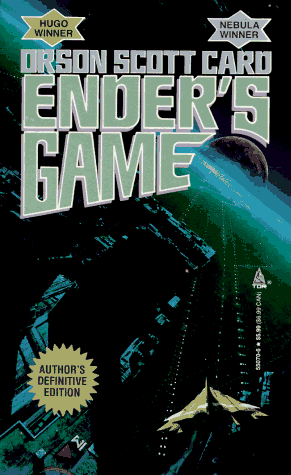
Book Review: Ender's Game


Well this is the kick off to my Science Fiction summer. Although I finished this book a little bit ago, I got behind because I started Dune. Even though I felt I was already traversing through the nerd universe in Ender's Game, I realized I was only in the shallow end once I started Dune.
However, I do not want to take away from Ender's Game, which I found to be a great novel. While slow to start, I can certainly see how and why this book receives so much praise. It is an in-depth look into the mind of a child who from an early age, has been inculcated with how to be a solider. One who is taught to not act or react with emotion, but rather strategy. Alienated from peers and family, Ender's life is in a constant state of preparation for battle. While this book does have its science fictions staples such as space travel and futuristic devices, it truly is a human story and should resonate with all readers. It is a coming of age story of a boy who must bear the fate on humanity on his shoulders. As Ender knows that once false move in his preparation could mean life or death for humanity as we know it, he still desires affirmation from his peers. He still longs for the love of his sister and constantly questions the meaning of all of his endeavors. Although one in an unusual circumstance, he is a boy at heart and that is what makes this story particularly poignant.

Back to the futuristic devices, I was also pretty amazed how Card predicted the future of the internet. Published in 1985, the internet was in no way ubiquitous. In Ender's world, the "nets" are a vital part of every citizens lives. Although we do not have elections held through the internet, it was interesting to read how Card predicted a world in which everyone relied on the internet. While that is not entirely the case now, I do know a couple people who might actually die if they went a day without logging on facebook.

Ender is a fascinated and fully realized character in a mostly realized world. Which brings me to my one gripe, I wish that Card gave us a bit more about the world around him. Why things are the way that they are? How exactly were the wars with the Buggers started?

While I do have my problems, I do know that there is much more to Ender's story that I have yet to read. So I cannot really fault him for not including these details because I have only read the first quarter of the whole series.

I just bought Speaker for the Dead today so I am in no way done with this story. With a complex and utterly human cast of characters living in a world in which I can not visualize, but understand, makes this story an important read.

So far, my Sci-Fi summer is going really well.

Tuesday, May 25, 2010

Book Review: Columbine


On April 20th 1999, my childhood changed. I remember coming home from school and seeing a young man, Patrick Ireland, being helped out of a window. His body wasn't moving in a fluid motion. It seemed as though he were taking his time while hundreds of others fled from the school. It wasn't until later that I found out that he had been shot in the head. I couldn't understand it at the time. I kept thinking to myself, why wasn't he attempting to get out of there faster? My brain kept trying to grapple with this idea that something of that magnitude could happen on a high school campus. They were too young. We were too young. What could bring someone do this?

There were no clean-cut answers, there will never be. However, everywhere America turned, there were answers. The myths that we cling to so fervently began to materialize in the days after the disaster, e.g: The Trench Coat Mafia, that the shooters were outcasts, that they were targeting their oppressors, that heavy music and cinema influenced their decisions. These myths became fact in the American psyche. It was truncated, shaped, and fit into a box that people (myself included) could understand. This allowed Americans to go forward with their lives and look at themselves in the mirror knowing that events like Columbine were merely freak accidents. Compartmentalizing tragedy may help to cope with the unexplainable, but it doesn't serve to illuminate truth.

Dave Cullen's book Columbine is an important step in attempting to reclaim the truth. Thoroughly researched and meticulously written, Cullen's book is breathtaking and focuses not only those young men who killed twelve of their fellow classmates that day, but also everyone who was in some way affected by their decisions. Cullen himself had taken part in the subsequent media bonanza that the massacre brought to the town and used the next ten years culling sources. By judiciously using the killers personal journals and interviews with the victims and their families, Cullen dispels commonly held myths and is able to make some sense out of this seemingly wanton calamity. This was not a fluke or a battle of good vs. evil. It was a matter of two kids who made a momentous decision, a town that was caught in the aftermath, and a nation in mourning.

I cannot express how important this book is. It is expertly written and delicately handles a topic that is so quick to conjure an emotional response. It does not seek to blame, but understand. Which is something that is rarely attempted in these types of situations.

It is simply one of the best non-fiction books I have read and I am glad that someone gave the massacre at Columbine a comprehensive and fair treatment.

I give this book 4 out of 4 dead horses!

Saturday, May 15, 2010

Summer Reading

I have always loved Science Fiction. The problem is that for every good science fiction book, there is most likely 12,000 awful books. Also, most series go on for 14-16 books so you cannot dabble in sci-fi. You either need to just take off your swim trunks altogether, or dive right in....to the deep end...and not come up for a while...because the water is so deep...you might hit your head...don't eat right before swimming...stomach cramps.

You get the picture. Sci-Fi is a serious undertaking.

As a guy who likes to get around the literary world (book whore), it is always tough for me to commit to one series for any length of time.

Yet, I am going to change that this summer. I remember the first time I read Phillip K. Dick. It was mind blowing. These novels do not adhere to any laws of the natural world, yet they have so much to say about our world and the nature of humanity. If you are a sci-fi fan, then you know what I am talking about. If your not, then you probably think I am a huge idiot and think I just like the idea of traveling through space.

Two things:
1) I do, because it would amazing
2) If you have written sci-fi off, then you're stupid. (In a fun way)

I am starting off with Orson Scott Card's "Ender's Game." Then I want to try to tackle the "Foundation" series by Isaac Asimov. Maybe some more Phil Dick in there for good measure.

If anyone wants to start with me, then I am starting Ender's Game in two days. Set your clocks. Actually don't, because time doesn't apply to where we are going. I can actually feel my girlfriend become less attracted to me the more and more I talk.

Saturday, March 6, 2010

Book Review: The Brief Wondrous Life of Oscar Wao


I don't know why I do this to myself. I don't really have the time to be reading novels. School already has me bogged down with more reading than I can handle. Yet, I always desire to force down a novel in my(non-existent)spare time. Just like a new years resolution, I vowed not to touch a book and focus solely on my school work. I would get ahead. I would be the student that every teacher dreams of. My professor would invite me to a special "excellent students club" in which only the elite in education are invited. However, as soon as I made that vow, a man at my coffee shop threw a book my way. It was, and still is, Junot Diaz's The Brief Wondrous Life of Oscar Wao.

When I first picked up this book one night, I was incredibly disappointed. In the same vein as Cormac Mccarthy and a slew of other authors, Diaz forgos being formal in his writing. Every line feels like you are merely reading a transcript of a conversation one would hear on the street. A conversation riddled with big words. While this approach allows the reader to really immerse his or herself in the story, it can also pull the reader out of the story when it feels too contrived. Many times I felt like Diaz was trying too hard to make it feel authentic. His colloquial style made me step back a couple of times and think to myself, "there is no way anybody would say that."

Faults aside, Diaz creates a very interesting story. Revolving primarily around a multi-generational family curse known as Fuku, Diaz tells the story from the perspective of different family members and how this so called curse has changed their lives. One of Diaz's strong suits is how he is able to weave a compelling story together with the real life events that took place during the vicious reign of Dominican dictator Rafael Leónidas Trujillo Molina. From the lovable Oscar who hopes to one day become the Dominican J.R Tolkien, to the distant relatives who brought the Fuku upon the famiy, Diaz braids together history and fiction in a way that is both enthralling and informative.

On an interesting note, I have not seen footnotes in a novel until I picked up this book. The footnotes supplement the references made about those characters and events that took place during the Trujillo's reign. While sometimes daunting, these do enhance the experience and give the reader a better picture of the Dominican Republic during this time. Also, it would help if the reader should have a minor grasp of rudimentary Spanish since the author frequently uses it without translation.

Overall, while the book is not without its shortcomings. It is a very enjoyable read and an experience I am sure most readers have not had with a novel in a long time.

I give this book 3 out of 4 dead horses.