Wednesday, October 10, 2012
It's Too Late To Apologize
Never will I apologize for not blogging more. In fact, I have an ongoing joke that the only reason people have blogs anymore is to apologize for not blogging more. So I will not seek forgiveness here as there is nothing that needs to be forgiven.
My blogging began to retard once it became apparent that nearly 90% of the American population had created one. Most of these blogs are brimming with minutia and have over-saturated the already dense internet. With so much useful information to be found, who really has the time to care if Claire found that pair of Steve Madden boots that she has been so feverishly searching for? And if they are too busy to worry themselves over Claire's plight, who am I to think that they're going to burden themselves with my half-cocked ravings?
Yet, in the end, one must push aside their concerns and sally forth toward a more promising future.
Did Christopher Columbus get mentally and physically fatigued from raping & ravaging the indigenous communities of the New World? Most likely. Did he let get to him? Not a chance. When so many of his contemporaries would have stopped, Columbus kept his eyes on the prize, and carried on.
In the spirit of the father of this great nation, apropos of the recent American holiday, I will not let this blog fade into the ether of negligence that has consumed countless others. I will carry on, I will prevail, I will continue to write.
And that my friends, is a promise?

Monday, April 25, 2011
Film Review: Barking Dogs Never Bite

A wickedly smart and hilarious black comedy/social satire from the master of South Korean cinema himself, Bong Joon-Ho. It is a film about a struggling graduate student (Sung-Jae Lee) caught up the seemingly endless rat race of everyday life. The Seoul of Joon-Ho's mind is filled with a burnt out population who feel that they can only achieve greatness through unscrupulous avenues or in the unlikely event that they will end up on television. When Lee seems to be on the precipice of madness due to constant societal demands, his rage is projected onto a neighbors dog. What ensues next is an opaque but comical attempt to dispatch the poor animal.
What sets Joon-Ho apart from his cohorts in Korean Cinema, namely Park Chan-Wook, is that he isn't there to solely shock the viewer. Sure the material makes for some surprising moments, but Joon-Ho brings up some important questions. Why do people pamper animals when they themselves must toil endlessly just to achieve sustenance? Why do people long to nourish animals when they are not nourished by their own caretakers?
It is an interesting and thought provoking film that is wrapped in a delightful black comedy and is definative proof that South Korean directors are some of the most premiere filmmakers of this generation.
Wednesday, April 13, 2011
Film Review: Taxi Driver

For me, this film really solidified my idea that you have never really seen a film until you have seen it twice. Upon my initial viewing more than five years ago, I was really only focused on DeNiro's performance. I knew that the film itself was special, yet at the time I did not have the faculty to really analyze the film and articulate what made it so powerful. While I will probably read this review five years from now and cringe at this rough attempt at film criticism, I am going to give it my best.
From the moment that Travis' cab emerges through the steam, one gets a sense that Scorsese is going to take us down a dark road. What he gives the viewer is an in depth character analysis that drives into the mind of a neurotic ex-marine teetering on the edge of delirium.
While writer Paul Schrader helped to bring Travis Bickle into existence, DeNiro and Scorsese really bring him to life. DeNiro, who drove an actual cab for a couple weeks in order to prepare for the role, uses the most subtle of expressions to showcase the many shades of turmoil that Bickle projects. As he walks amid the maelstrom of New York City at night, his demeanor is placid, yet something is clearly boiling beneath the surface. In the hands of many other actors, Travis would have turned out more ostentatiously psychopathic and I find DeNiro creates a malevolence that is even more sinister by making Travis oddly endearing.
On paper Travis is not a simple man. Whether it be in his cab or his rather scanty apartment, he is usually shown in a constant state of isolation. Even Scorsese's direction stresses this isolation as he is usually the lone figure in the frame during a conversation while the other person is usually shot with Travis' shoulder in the foreground. He is intuitive, smart, confident, and believes himself to be a John Wayne figure even though he is more akin to Norman Bates. He is also a walking contradiction. Bickle becomes obsessed with fitness even though he predominately eats junk food and proclaims his distaste for people's licentious activities even though he frequents dirty movies. DeNiro's performance effectively encompasses all the complexities that a character such as Travis has to offer.
As for Scorsese part, he does an excellent job accenting the pieces of the city that a person such as Travis would fixate on. Scorsese's New York is gritty and ominous. As Travis' cab drives around the city, Scorsese shows that there is wanton violence at every turn. Whether this is the New York that Scorsese sees or just Bickle's perception of it, it is not depicted as a place to settle down and start a family. (Unless of course you plan to eventually kill everyone in it) Even when Travis is outside of the cab, he is bathed in the red glow of the neon lights which also brilliantly foreshadows the violence that will ensue later.
Forgive me for my tedious rehashing of all the things that make this film so memorable. I hope that it might have given some insight into the powerful piece of film that Scorsese and DeNiro have created. It is surely one that cannot afford to be missed and belongs in every film lovers collection.
Wednesday, April 6, 2011
Movie Review: Who's Afraid of Virginia Woolf?

Sadly, there are very few films that are capable of eliciting a visceral reaction out of me. However, Mike Nichol's 1966 debut film, Who's Afraid of Virginia Woolf?, is such a powerful film on so many levels that I cannot imagine anybody watching it without being significantly moved. The film is based on Edward Albee's Tony Award winning play and covers the events of one very long and alcohol induced night. It follows the plight of an aging couple George (Richard Burton) and Martha (Elizabeth Taylor). When friends Nick (George Segal) and Honey (Sandy Dennis) come over for a nightcap, they become caught in the middle of a series of games in which George and Martha take their pain and attempt to push each other to the breaking point. Albee's dialogue is explosive, both in terms of being emotionally charged and how it is projected, and is adeptly handled by the entire cast.. There is a brilliant mix of temperamental humor and anguish which includes one of my favorite lines, "There isn't an abomination award going that you haven't won."
While Albee's superb script provides a well-built chassis for the film, it is Nichol's direction mixed with Haskell Wexler's brilliant cinematography that makes this film really take off. Often times the camera will capture the scene as if it were merely a fly on the wall. However, Nichols really knows the material and will zoom in to the point of intrusion when a character feels emotionally isolated or verbally backed into a corner. In one particularly distinguished scene that deviates from the play, Nichols captures George walking into the back of the house when the Martha and the guests are still conversing in the living room. Even though George is out of ear shot of the others, Nichols keeps the audio of their conversation going while he follows George. This illuminates the extent of Martha's deviance as George can still knows that Martha will be speaking ill of him even when he is not in her company. Also, in the same vein as a noir, Nichols uses mirrors to show how these characters never take a good hard look at themselves and what they have become. One is even shoved in the face of George at one point, yet he is too steeped in his own misery to even see the man on the other side.
The performances here are simply astounding by all players involved. Although Taylor would nab the Oscar for best actress, I really feel as though Burton was snubbed. While his character could have just been watered down to nothing more than a dispensary of caustic wit, Burton injects a sense of humanity into the character that is present in the smallest of gestures.
Historically, this film is bold as it was produced in some of the most impassioned years of the civil rights movement. These years saw a mass movement to finally put an end to the anti-miscegenation laws that had previously prevented interracial marriages in America. This film shows that even white upper-middleclass marriages, which were seen as a bulwark against the decay of the human race, had their blemishes.
In the end, it is a beautiful film about a volatile relationship. It is about pain and the fiction that we manufacture in order to deal with it. The film isn't easy to watch, but if you do you will find that this is an absolutely astounding film.
Tuesday, March 29, 2011
Review: 400 Blows

François Truffaut's 1959 semi-autobiographical piece regarding indolent youth and the society that generates them is captivating, elegantly conceived, and still feels robust even 50 years after it's conception. Through the film's protagonist Antoine (Jean-Pierre Leaud), the director shows the multi-faceted nature of adolescence. Whether it is with his camera, in scenes such as the one where Antoine is sitting before 3 different mirrors which all capture different aspects of his physique, or with his direction, in which it seems as though Truffaut's life has been inculcated into the young actor through osmosis, Truffaut displays the complexities of youth in an honest and cogent manner.
As far as education goes, the adults in this story don't seem to be interested in developing nuance, but rather a future race of citizens with the very same set of ideals. Many of the lessons we are shown in the film have to do with the children's memorization and regurgitation of old poems. When this proves futile, the teacher exclaims that France will be in sorry shape in the next ten years. Truffaut shows the damage that this type of education brings by highlighting one child as he fights to write the words down even as the inkwell is leaking onto the pages, defiling his skin, and staining the very nature of who he is.
Caught between an adulterous mother and an apathetic father, Antoine's one saving grace is the cinemas. Truffaut's true love for film comes out in these scenes as he captures the boy's sense of wonder as he marvels at the celluloid before him. Truffaut even includes a scene of Antoine stealing a still of Welles' Citizen Kane. A touching tribute to another young and influential filmmaker.
This being my first film that I have seen of the Nouvelle Vague, I am not yet familiar with all of the visual staples of this movement. Yet, you would have to be visually impaired not to see how beautifully shot this film is. From the tracking shots in the classroom to illuminate the idiosyncrasies of the classroom environment to the POV shots used to show the physical and mental imprisonment of Antoine, Truffaut judiciously uses his camera to expound a particular mood.
While I know that only the further consumption of films from the New Wave will help me to better understand the universal importance of this movement, if the 400 Blows is any indication, I will not be let down.
Monday, March 28, 2011
Film Reviews
I have been taking a stab at film reviews lately. It is just a selfish exercise for me but maybe some of you could find something that you might want to watch out of it. Maybe not, but here it goes.
My first film is Akira Kurosawa's Stray Dog

While someone could make the argument that all cinema is poetic in certain ways, no set of films personify cinematic poetry more than the films of Akira Kurosawa. Even in his earlier films such as Stray Dog, he gives the viewer a generous bounty to chew on. Not only is this a noir influence crime drama, but a priceless time capsule of the Japanese experience in the aftermath of a devastating World War. In the vein of Italian Neorealism, Kurosawa captures the essence of everyday life in a land ravaged by war. While the film focuses on Detective Murakami's (Toshiro Mifune) pursuit to find his missing Colt from the criminal Yusa, Kurosawa doesn't give us a cut and dry story of good versus evil. In fact, the story is rather messy. Like the characters in this story, all of Japan is in the grasps of what appears to be bedlam. Filmed in 1949, Japan's black market was still running rampant during this time and the film features a lengthy montage of actual footage of the black market. In a time with such rampant poverty, class disparity, and widespread vice, the film begs the question what constitutes crime when the entire land is beset by turmoil? Kurosawa is constantly blurring the lines between good and bad and in one particularly compelling scene has both the "hero" and "villan" wrestling in some mud and coming out looking nearly identical.
The film also oscillates between rapidly paced scenes with quick edits and long static takes in which Kurosawa really takes his time in telling the story. This can be rather laborious to watch for someone who has grown up on a steady diet of Transformers and Fast and Furious. In many scenes where the action seems to be near a climax, Kurosawa lets his characters light a cigarette in the middle of a pivotal exchange. Tedious as it may seem for some to get through, Kurosawa let's you really revel in the moment. If you take the director up on his invitation rather than throw your hands up in vexation, there is much on screen to reward you.
There are some skillfully choreographed shots that put many modern films to shame. Also, much like his other films Rashomon and Ikiru, he focuses heavily on the weather to symbolize either the beauty or the turbulence that the characters are experiencing internally. These are just a few examples of the many motifs that Kurosawa employs. Although it is one of his earlier pieces, it certainly illuminates Kurosawa's exceptional proficiency in terms of filmmaking.
My first film is Akira Kurosawa's Stray Dog

While someone could make the argument that all cinema is poetic in certain ways, no set of films personify cinematic poetry more than the films of Akira Kurosawa. Even in his earlier films such as Stray Dog, he gives the viewer a generous bounty to chew on. Not only is this a noir influence crime drama, but a priceless time capsule of the Japanese experience in the aftermath of a devastating World War. In the vein of Italian Neorealism, Kurosawa captures the essence of everyday life in a land ravaged by war. While the film focuses on Detective Murakami's (Toshiro Mifune) pursuit to find his missing Colt from the criminal Yusa, Kurosawa doesn't give us a cut and dry story of good versus evil. In fact, the story is rather messy. Like the characters in this story, all of Japan is in the grasps of what appears to be bedlam. Filmed in 1949, Japan's black market was still running rampant during this time and the film features a lengthy montage of actual footage of the black market. In a time with such rampant poverty, class disparity, and widespread vice, the film begs the question what constitutes crime when the entire land is beset by turmoil? Kurosawa is constantly blurring the lines between good and bad and in one particularly compelling scene has both the "hero" and "villan" wrestling in some mud and coming out looking nearly identical.
The film also oscillates between rapidly paced scenes with quick edits and long static takes in which Kurosawa really takes his time in telling the story. This can be rather laborious to watch for someone who has grown up on a steady diet of Transformers and Fast and Furious. In many scenes where the action seems to be near a climax, Kurosawa lets his characters light a cigarette in the middle of a pivotal exchange. Tedious as it may seem for some to get through, Kurosawa let's you really revel in the moment. If you take the director up on his invitation rather than throw your hands up in vexation, there is much on screen to reward you.
There are some skillfully choreographed shots that put many modern films to shame. Also, much like his other films Rashomon and Ikiru, he focuses heavily on the weather to symbolize either the beauty or the turbulence that the characters are experiencing internally. These are just a few examples of the many motifs that Kurosawa employs. Although it is one of his earlier pieces, it certainly illuminates Kurosawa's exceptional proficiency in terms of filmmaking.
Wednesday, November 24, 2010
Catch Up Book Reviews: Part 1
In case you didn't know. I got married. I got married to a woman. It is on paper. The government recognizes it, but sadly my parents don't....
Although the wedding preparations didn't put a damper on my reading, it did hinder me from writing my incredibly average book reviews. This to me is the worst casualty of all. I feel bad that I let everyone down.
I have been receiving emails from people whom have been walking around aimlessly in their local Borders book shop. A vacant hole resides where my literary guidance use to be and for that...I feel ashamed. I even received an email from someone who ended up buying the Autobiography of Kate Hudson because she was without my counsel.
Well folks, I am back and I am here to enlighten you by sharing my opinions on current books that I have absorbed. (Either read or rubbed on my body until the ink came off onto my skin)
In order to catch up, I will have to summarize my reading endeavors of the past couple months. While they will not be as in depth as past reviews, I will assure you that they will be very powerful. Also, they will come in installments since I don't have a ton of time. Here is the first couple!
Here we go:

The first book that I tackled was the late Steig Larson's world sensation, The Girl With The Dragon Tattoo. While a lot darker than I originally expected, I don't feel it deserves half of the praise that it gets. It set itself up to be a murder mystery that was chalk full of twists and turns, but turned out to be a somewhat interesting mystery/business thriller with a payoff that was less than exciting. In fact, it kind of made me feel cheated. So while not awful, not worth the price. 2 out of 4 dead horses.

The next book I checked out was Andrew Ross Sorkin's, Too Bit To Fail. Sorkin's book is an amazingly thorough account of how the subprime mortgage crisis put the entire financial sector at risk of failure. Starting around Bear Stearns sale to J.P Morgan Chase and climaxing with the implementation of T.A.R.P (Troubled Asset Relief Program), Sorkin gives the readers unprecedented access into the minds of those who held America's financial system in their hands. Whether motivated by greed or just by the desire to keep the system afloat, Sorkin gives the reader the whole picture. While I think some could argue that it was a couple hundred pages too long, I feel the length was necessary to paint a complete picture of the disaster. Overall, if you are not interested in the crisis, stay far away. (Or if you are having trouble sleeping, this could actually help a lot) This is in depth and at times downright depressing. Yet, if you can stick it out, you will be handsomely rewarded. 3 and 1/2 out of 4 dead horses.
Although the wedding preparations didn't put a damper on my reading, it did hinder me from writing my incredibly average book reviews. This to me is the worst casualty of all. I feel bad that I let everyone down.
I have been receiving emails from people whom have been walking around aimlessly in their local Borders book shop. A vacant hole resides where my literary guidance use to be and for that...I feel ashamed. I even received an email from someone who ended up buying the Autobiography of Kate Hudson because she was without my counsel.
Well folks, I am back and I am here to enlighten you by sharing my opinions on current books that I have absorbed. (Either read or rubbed on my body until the ink came off onto my skin)
In order to catch up, I will have to summarize my reading endeavors of the past couple months. While they will not be as in depth as past reviews, I will assure you that they will be very powerful. Also, they will come in installments since I don't have a ton of time. Here is the first couple!
Here we go:

The first book that I tackled was the late Steig Larson's world sensation, The Girl With The Dragon Tattoo. While a lot darker than I originally expected, I don't feel it deserves half of the praise that it gets. It set itself up to be a murder mystery that was chalk full of twists and turns, but turned out to be a somewhat interesting mystery/business thriller with a payoff that was less than exciting. In fact, it kind of made me feel cheated. So while not awful, not worth the price. 2 out of 4 dead horses.

The next book I checked out was Andrew Ross Sorkin's, Too Bit To Fail. Sorkin's book is an amazingly thorough account of how the subprime mortgage crisis put the entire financial sector at risk of failure. Starting around Bear Stearns sale to J.P Morgan Chase and climaxing with the implementation of T.A.R.P (Troubled Asset Relief Program), Sorkin gives the readers unprecedented access into the minds of those who held America's financial system in their hands. Whether motivated by greed or just by the desire to keep the system afloat, Sorkin gives the reader the whole picture. While I think some could argue that it was a couple hundred pages too long, I feel the length was necessary to paint a complete picture of the disaster. Overall, if you are not interested in the crisis, stay far away. (Or if you are having trouble sleeping, this could actually help a lot) This is in depth and at times downright depressing. Yet, if you can stick it out, you will be handsomely rewarded. 3 and 1/2 out of 4 dead horses.
Tuesday, July 13, 2010
Book Review: Ender's Game
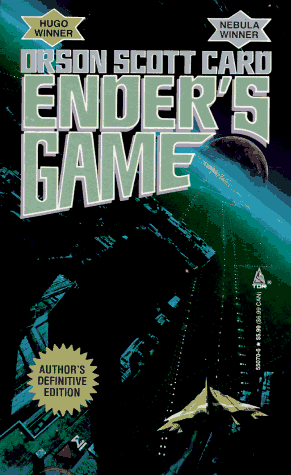
Well this is the kick off to my Science Fiction summer. Although I finished this book a little bit ago, I got behind because I started Dune. Even though I felt I was already traversing through the nerd universe in Ender's Game, I realized I was only in the shallow end once I started Dune.
However, I do not want to take away from Ender's Game, which I found to be a great novel. While slow to start, I can certainly see how and why this book receives so much praise. It is an in-depth look into the mind of a child who from an early age, has been inculcated with how to be a solider. One who is taught to not act or react with emotion, but rather strategy. Alienated from peers and family, Ender's life is in a constant state of preparation for battle. While this book does have its science fictions staples such as space travel and futuristic devices, it truly is a human story and should resonate with all readers. It is a coming of age story of a boy who must bear the fate on humanity on his shoulders. As Ender knows that once false move in his preparation could mean life or death for humanity as we know it, he still desires affirmation from his peers. He still longs for the love of his sister and constantly questions the meaning of all of his endeavors. Although one in an unusual circumstance, he is a boy at heart and that is what makes this story particularly poignant.
Back to the futuristic devices, I was also pretty amazed how Card predicted the future of the internet. Published in 1985, the internet was in no way ubiquitous. In Ender's world, the "nets" are a vital part of every citizens lives. Although we do not have elections held through the internet, it was interesting to read how Card predicted a world in which everyone relied on the internet. While that is not entirely the case now, I do know a couple people who might actually die if they went a day without logging on facebook.
Ender is a fascinated and fully realized character in a mostly realized world. Which brings me to my one gripe, I wish that Card gave us a bit more about the world around him. Why things are the way that they are? How exactly were the wars with the Buggers started?
While I do have my problems, I do know that there is much more to Ender's story that I have yet to read. So I cannot really fault him for not including these details because I have only read the first quarter of the whole series.
I just bought Speaker for the Dead today so I am in no way done with this story. With a complex and utterly human cast of characters living in a world in which I can not visualize, but understand, makes this story an important read.
So far, my Sci-Fi summer is going really well.
Tuesday, May 25, 2010
Book Review: Columbine

On April 20th 1999, my childhood changed. I remember coming home from school and seeing a young man, Patrick Ireland, being helped out of a window. His body wasn't moving in a fluid motion. It seemed as though he were taking his time while hundreds of others fled from the school. It wasn't until later that I found out that he had been shot in the head. I couldn't understand it at the time. I kept thinking to myself, why wasn't he attempting to get out of there faster? My brain kept trying to grapple with this idea that something of that magnitude could happen on a high school campus. They were too young. We were too young. What could bring someone do this?
There were no clean-cut answers, there will never be. However, everywhere America turned, there were answers. The myths that we cling to so fervently began to materialize in the days after the disaster, e.g: The Trench Coat Mafia, that the shooters were outcasts, that they were targeting their oppressors, that heavy music and cinema influenced their decisions. These myths became fact in the American psyche. It was truncated, shaped, and fit into a box that people (myself included) could understand. This allowed Americans to go forward with their lives and look at themselves in the mirror knowing that events like Columbine were merely freak accidents. Compartmentalizing tragedy may help to cope with the unexplainable, but it doesn't serve to illuminate truth.
Dave Cullen's book Columbine is an important step in attempting to reclaim the truth. Thoroughly researched and meticulously written, Cullen's book is breathtaking and focuses not only those young men who killed twelve of their fellow classmates that day, but also everyone who was in some way affected by their decisions. Cullen himself had taken part in the subsequent media bonanza that the massacre brought to the town and used the next ten years culling sources. By judiciously using the killers personal journals and interviews with the victims and their families, Cullen dispels commonly held myths and is able to make some sense out of this seemingly wanton calamity. This was not a fluke or a battle of good vs. evil. It was a matter of two kids who made a momentous decision, a town that was caught in the aftermath, and a nation in mourning.
I cannot express how important this book is. It is expertly written and delicately handles a topic that is so quick to conjure an emotional response. It does not seek to blame, but understand. Which is something that is rarely attempted in these types of situations.
It is simply one of the best non-fiction books I have read and I am glad that someone gave the massacre at Columbine a comprehensive and fair treatment.
I give this book 4 out of 4 dead horses!
Saturday, May 15, 2010
Summer Reading
I have always loved Science Fiction. The problem is that for every good science fiction book, there is most likely 12,000 awful books. Also, most series go on for 14-16 books so you cannot dabble in sci-fi. You either need to just take off your swim trunks altogether, or dive right in....to the deep end...and not come up for a while...because the water is so deep...you might hit your head...don't eat right before swimming...stomach cramps.
You get the picture. Sci-Fi is a serious undertaking.
As a guy who likes to get around the literary world (book whore), it is always tough for me to commit to one series for any length of time.
Yet, I am going to change that this summer. I remember the first time I read Phillip K. Dick. It was mind blowing. These novels do not adhere to any laws of the natural world, yet they have so much to say about our world and the nature of humanity. If you are a sci-fi fan, then you know what I am talking about. If your not, then you probably think I am a huge idiot and think I just like the idea of traveling through space.
Two things:
1) I do, because it would amazing
2) If you have written sci-fi off, then you're stupid. (In a fun way)
I am starting off with Orson Scott Card's "Ender's Game." Then I want to try to tackle the "Foundation" series by Isaac Asimov. Maybe some more Phil Dick in there for good measure.
If anyone wants to start with me, then I am starting Ender's Game in two days. Set your clocks. Actually don't, because time doesn't apply to where we are going. I can actually feel my girlfriend become less attracted to me the more and more I talk.

You get the picture. Sci-Fi is a serious undertaking.
As a guy who likes to get around the literary world (book whore), it is always tough for me to commit to one series for any length of time.
Yet, I am going to change that this summer. I remember the first time I read Phillip K. Dick. It was mind blowing. These novels do not adhere to any laws of the natural world, yet they have so much to say about our world and the nature of humanity. If you are a sci-fi fan, then you know what I am talking about. If your not, then you probably think I am a huge idiot and think I just like the idea of traveling through space.
Two things:
1) I do, because it would amazing
2) If you have written sci-fi off, then you're stupid. (In a fun way)
I am starting off with Orson Scott Card's "Ender's Game." Then I want to try to tackle the "Foundation" series by Isaac Asimov. Maybe some more Phil Dick in there for good measure.
If anyone wants to start with me, then I am starting Ender's Game in two days. Set your clocks. Actually don't, because time doesn't apply to where we are going. I can actually feel my girlfriend become less attracted to me the more and more I talk.

Saturday, March 6, 2010
Book Review: The Brief Wondrous Life of Oscar Wao

I don't know why I do this to myself. I don't really have the time to be reading novels. School already has me bogged down with more reading than I can handle. Yet, I always desire to force down a novel in my(non-existent)spare time. Just like a new years resolution, I vowed not to touch a book and focus solely on my school work. I would get ahead. I would be the student that every teacher dreams of. My professor would invite me to a special "excellent students club" in which only the elite in education are invited. However, as soon as I made that vow, a man at my coffee shop threw a book my way. It was, and still is, Junot Diaz's The Brief Wondrous Life of Oscar Wao.
When I first picked up this book one night, I was incredibly disappointed. In the same vein as Cormac Mccarthy and a slew of other authors, Diaz forgos being formal in his writing. Every line feels like you are merely reading a transcript of a conversation one would hear on the street. A conversation riddled with big words. While this approach allows the reader to really immerse his or herself in the story, it can also pull the reader out of the story when it feels too contrived. Many times I felt like Diaz was trying too hard to make it feel authentic. His colloquial style made me step back a couple of times and think to myself, "there is no way anybody would say that."
Faults aside, Diaz creates a very interesting story. Revolving primarily around a multi-generational family curse known as Fuku, Diaz tells the story from the perspective of different family members and how this so called curse has changed their lives. One of Diaz's strong suits is how he is able to weave a compelling story together with the real life events that took place during the vicious reign of Dominican dictator Rafael Leónidas Trujillo Molina. From the lovable Oscar who hopes to one day become the Dominican J.R Tolkien, to the distant relatives who brought the Fuku upon the famiy, Diaz braids together history and fiction in a way that is both enthralling and informative.
On an interesting note, I have not seen footnotes in a novel until I picked up this book. The footnotes supplement the references made about those characters and events that took place during the Trujillo's reign. While sometimes daunting, these do enhance the experience and give the reader a better picture of the Dominican Republic during this time. Also, it would help if the reader should have a minor grasp of rudimentary Spanish since the author frequently uses it without translation.
Overall, while the book is not without its shortcomings. It is a very enjoyable read and an experience I am sure most readers have not had with a novel in a long time.
I give this book 3 out of 4 dead horses.
Monday, February 15, 2010
Book Club
I know this is kind of dead in the water. I am just letting everyone know that I just started The Brief and Wondrous Life of Oscar Wao if anyone wants to join me.
Book Review: Sarah Palin's Going Rogue
I don't really know what to say, I only made it through the first chapter. I have never felt so filthy after reading a chapter of a book. The first chapter is her talking about how she is a straight shooter and that is why she wanted to get into politics. That she is kind of a people person that could cut through the political jargon and get to the heart of the american people. She got to me and I personally feel sick.
I'll let you know if I read more. As of right now....
I give it a quarter of 1 dead horse
I'll let you know if I read more. As of right now....
I give it a quarter of 1 dead horse
Wednesday, December 16, 2009
Time Magazine Has Lost All Credibility
I have a love/hate relationship with top ten lists. Some people actually put some thought into theirs and can express what they feel are their top favorite albums of the year. Others just throw together every album they can think of and don't really have to pick and choose. While others, just seem to compile a list of many different genres of music just to build "Street Cred."
A good example of this is seen with Time Magazine's Top Ten Albums of the Year. I was initially drawn to it because it has Mastodon's Crack the Skye on it, which happens to be one of my favorite albums of the year. Then I made the mistake of looking at their other selections. While I don't want to go into every horrible decision they made, I will highlight one. They gave Brad Paisley the best album of the year. Aside from the fact that I despise nearly everything on CMT, Time Magazine didn't really have a good reason as to why is was their favorite album. This was part of what they said about it,
"The real risk-taking emerges on his songs about women, which, as on the brilliant "The Pants," manage to be funny, sexy and sensitive: "In the top drawer of her dresser there's some panties/ Go try on that purple pair with the lacy frill/ With your big old thighs I bet you can't get in 'em/ With that attitude of yours, hell, I bet you never will."
The great thing is that I don't have to make a joke, since it is not funny. It is sad.
A good example of this is seen with Time Magazine's Top Ten Albums of the Year. I was initially drawn to it because it has Mastodon's Crack the Skye on it, which happens to be one of my favorite albums of the year. Then I made the mistake of looking at their other selections. While I don't want to go into every horrible decision they made, I will highlight one. They gave Brad Paisley the best album of the year. Aside from the fact that I despise nearly everything on CMT, Time Magazine didn't really have a good reason as to why is was their favorite album. This was part of what they said about it,
"The real risk-taking emerges on his songs about women, which, as on the brilliant "The Pants," manage to be funny, sexy and sensitive: "In the top drawer of her dresser there's some panties/ Go try on that purple pair with the lacy frill/ With your big old thighs I bet you can't get in 'em/ With that attitude of yours, hell, I bet you never will."
The great thing is that I don't have to make a joke, since it is not funny. It is sad.
Friday, December 4, 2009
Semantics
I am starting to realize that when you look at blogs, the person who uses the biggest words usually have no idea what they are talking about. Some people can utilize these words to make what they say clearer and more concise. Yet, most people just toss them around hoping that someone will get lost in what they say and click out of that window thinking, "Damn that guy is smart."
I see this a lot in christian blogs. Don't get me wrong, I am pumped that they are having a rousing conversation. Yet, if they really want to turn people onto God, they should be able to talk about it in layman's terms. I could be wrong, but most of the conversations I have eve's dropped on that include the common athiest, terms such as "Kalam Cosmological argument" and "Epiphenomenonalism." (Yes I just looked these words up)
Isn't it crazy. It's just so painfully axiomatic
I see this a lot in christian blogs. Don't get me wrong, I am pumped that they are having a rousing conversation. Yet, if they really want to turn people onto God, they should be able to talk about it in layman's terms. I could be wrong, but most of the conversations I have eve's dropped on that include the common athiest, terms such as "Kalam Cosmological argument" and "Epiphenomenonalism." (Yes I just looked these words up)
Isn't it crazy. It's just so painfully axiomatic
Wednesday, December 2, 2009
Album Review: The Mars Volta - Octahedron

Along with now doing book reviews, I am going to be reviewing all types of media. Being human, I presuppose that my interests are also of interest to all of you. Along with this presupposition (I’m so smart), I believe that my interests have not only set a bar in excellence that the rest of the world should be striving to achieve, but I believe that everyone would be completely lost without my guidance. As much as I am mocking this thought, I still believe it. Silly as it may seem, you all believe it too. But enough of that. Sit back and let me exercise this savior complex of mine.
This will be the first compact disc review I have ever done for this blog. (If you are reading this blog in the future, a compact disc was something that was awesome. It wasn’t a series of 1’s and 0’s that now float solely through your I-Tunes or MP3Toilet.com or whatever Internet application now services your musical needs. It was a series of 1’s and 0’s compiled on a round piece of plastic that I could carry around and show off to my friends, take on a trip, or listen to in my car. I didn’t have to consult my failing PC everytime I wanted to listen to Fountains of Wayne, I just grabbed it out of my leather-bound case. I think you get the point. It was amazing. Enjoy your new Timbaland single because I assume Cds are obsolete now too. Man the future sucks already.)
This review will be a part of a series I call “Under the Radar.” These aren’t brand spanking new albums. (By the way, Brand “Spanking” New? Why Spanking? I hate tradition.) These are albums that may have been out for a while. Yet, I believe they need revisiting because they have not gotten the credit they deserve and in a way have flown under the radar.
Tonight’s Album: The Mars Volta – Octahedron
This album was a very unexpected turn for the Mars Volta. After their critically acclaimed effort “Deloused in the Comatorium,” they seemed to keep adding new members. While I do know that from the very onset they utilized other musicians, for example Flea from the currently unimaginative Red Hot Chili Peppers, played bass on Deloused. Yet, after that album dropped I kept on hearing about them acquiring new members. Most notably former At The Drive In band mate Paul Hinojos dropped his role in the band Sparta to join the onslaught of new musicians. While they managed to hold it together for their second release “Frances the Mute”, this rise in numbers coupled with the fact that they began to favor noise over melody made for the half-hearted attempt that was their third album, “Amputecture” While tracks such as “Viscera Eyes” has it’s moments, you can actually hear the musicians put their heads up their own arses throughout most of the album. Omar Rodriguez-Lopez didn’t even play guitar on it. John Frusciante of the aforementioned currently unimaginative Red Hot Chili Peppers played guitar on the album. While I hope it was fun for the band, it certainly wasn’t incredibly pleasing to their audience. Needless to say, the band was losing fans as they continued to welcome in new band members. This juggernaut of a sloppily put together supergroup was losing its focus.
It seemed my worst fears continued to materialize as I received the news that drummer Jon Theodore left. I loved “Deloused in the Comatorium” and I know a big reason for that was his presence on the album. While new drummer Thomas Pridgen's presence on their 4th album “Bedlam in Goliath” makes me feel like his free time is filled primarily with doing speed and watching Neil Pert solos, it was a solid album. It was cohesive, it made sense, and it was done all while reminding listeners why we loved The Mars Volta in the first place.
Which now brings me to their latest effort Octahedron. This album finds The Mars Volta’s sound very stripped down. Not only did they fire some of the band, including Hinojos which I am not too happy about, they wrote what Rodriguez-Lopez calls their “acoustic album.” While this album does feature more acoustic guitar than their previous releases, this is by no means an “acoustic” album. It is a more relaxed sound, but the songs are still big. They feel more intentional and contained rather than improvisational and disconnected. While they still have familiar staples such as bizarre song titles likes, “Halo of Nembutals”, this is a new direction for that band that I feel is exactly what they needed. While I could try to sit down and describe every fill and riff contained within Octahedron, I feel like it wouldn’t come across well and frankly that sounds like too much work for me.
I do not know why this album was not pushed by Universal as much as their previous releases, but I feel like this is one of the best albums in the Mars Volta’s canon. Years after the disintegration of At The Drive In and 4 albums deep into their new project, Cedric Bixler-Zavala and Omar Rodriguez-Lopez still continue to make great music. While they may lose their way here and there, Octahedron shows that they are still one of the more important bands rock music has right now.
Monday, November 23, 2009
Book Review: I Drink For A Reason

Welcome to the next installment of Reid reviews books.
While this has not been formally announced, I will be using this blog to also review books that I have been reading. While I do enjoy movies and music, I have never felt really comfortable reviewing them. I don't always catch on to the Freudian undertones that are so pervasive in movies such as X-Men 3: The Last Stand. I didn't really catch on to the post 9/11 themes prevalent in The Scorpion King. However, I do feel like I can understand books well enough to guide the masses. (By masses I mean the 2 followers who currently subscribe to my blog) I am not applying for a job at the New Yorker anytime soon, but I am a fairly consistent reader and feel I can come up with a unique take on a book. If I fail to do so, I will read other reviews of the book and blatantly rip off their ideas and pass them off as my very own. (I'm desperate for respect) In my reviews, I will also use one big word that shouldn't be used. I will use this to A:) Sound very intelligent and B:) See A
Tonight's review is of David Cross' I Drink For A Reason:
My initial thought when gazing at the cover of this book was "Yipee! I love David Cross. His book will bring me enjoyment on many different occasions." (Keep in mind I am paraphrasing and taking many liberties with my memories) I love David Cross' comedy specials and his character on Arrested Development was amazing, so how could I go wrong? Simple. Him not writing a very good book.
Once in a while Cross' stand up comedy relies on his sardonic observations on life. He usually does a pretty good job of riding the fine line between bitter commentary and sheer comedic genius. Yet, it seems as though on this writing venture he drank a bottle of Jamison Irish Whiskey, threw caution to the wind, wrote this book containing nothing but his hatred for all aspects of life, and mostly likely concluded the night by getting into an argument with his sprinkler system.
This is not a very flattering side of David. He does seem to be a very intelligent man and I will still call myself a fan of his, but he still is an entertainer. If this was a book by Dr. Sanjay Gupta, I would probably give him a pass because his job isn't to make us laugh. (Even though his newest book Cheating Death has been known to make people snicker once and a while) Yet, David is a comedian and I rarely even smiled during this book. Critics of my blog, if I ever have any, will say that David's style of humor is very deadpan. I appreciate that when there is a payoff. This book was so deadpan that is never came to life for me. (Does the Pulitzer Committee award excellence in blogging?)
If you are a person who is parsimonious (look it up), then don't waste your time on this book. Even if you are loaded, don't spend time on this book. If you're an anthropology major who hates everything anyway, you'll love it.
I give this book 1 dead horse out of 4.
Sunday, November 22, 2009
Book Review: She's Come Undone

I am a guy who likes to see what all the fuss is about. When the Da Vinci code was finally allowing the CEO of Random House to fulfill his lifelong dream of wiping his bottom with 100 dollar bills, part of that hundred was mine. When the Kite Runner was making middle aged housewives finally care about children from other countries, I shared their concern. When Stephanie Meyers was finally about to pull herself out of the Utah soccer mom slums with teenage vampire porn quadrilogy Twilight, I was rooting (silently) for Bella. Needless to say, when a book is creating a lot of buzz, I will read it. Lots of heartache comes with this because a lot of these books turn out to be pretty bad. Kite Runner was fairly disappointing, the Da Vinci code was exciting yet forgettable, and Twilight could/may have been ghostwritten by a fourth grader. People get bored, something becomes hip, they (we) ride the train for a bit, then inevitably get off as soon as it's done. However, I do believe Wally Lamb's She's Come Undone lived up to most of the hype surrounding it.
She's Come Undone chronicles the life of Dolores Price. Dolores, isn't the most likable protagonist. In fact, at times she is repulsive. Mean, impulsive, and selfish are not the qualities that make up a very likable main character, but they are qualities every reader can empathize with. While I cannot imagine anyone going through all of the turmoil that Dolores endures in the novel, I think everyone can see a little bit of themselves in her.
While in the beginning I wondered if Wally Lamb was only attempting to write the most depressing novel ever, the payoff is the third act. Without giving away anything, Lamb brings the novel to an end not afraid to let the reader wonder. There are rarely neat and tidy resolutions in life, tragedy doesn't adhere to rhyme or reason, and not everything can be understood. Lamb leaves the character as she is. If I am going to be honest, since finishing the book I have thought about "Dolores Price" on numerous occasions and what she may be doing at that very moment.
Overall, Lamb's literary debut is a well written and moving piece.
I give this book 3 dead horses out of 4
Wednesday, November 18, 2009
The Nature of Reading.
A man ought to read just as inclination leads him,
for what he reads as a task will do him little good.
~ Samuel Johnson ~
Books like friends, should be few and well-chosen.
~ Joineriana ~
These are some quotes that sum up some of the various feelings regarding reading. I was having a long conversation with one of my close friends last night and we had a little argument on the nature of reading.
My friend's view of reading seems to line up with the quote of Joineriana. That one should only read something that pushes the mind forward. For him, this means "classic" texts that have been deemed classic by magazine publications, the modern library, or are mandatory in college or high school. Classic novels coupled with philosophical or theological texts that push your brain should be a reader's main focus.
While I understand and respect that point of view, I tend to agree more with the Johnson quote above. I believe that reading the "classics" and other respected texts are very important. I also believe that you should read whatever makes you happy. While you should still be objective towards everything you set before your eyes, don't overlook a book just because it is new or by someone that you have never heard of. Classic writers are amazing, I understand now how people have fallen in love with the works of Orwell, Dostoyevsky, Plath, and Vonnegut, because I have fallen in love with them too. Yet, contemporary writers such as Marquez, Eugenides, McCarthy, Walls have also made me fall in love with them too. They have a voice too and while they haven't been along to be seen as classic, I still think you should just read what makes you happy.
If it becomes a task in order to become "enlightened" with every page, it will become akin to homework. Reading should be special, private, and above all else, a joy.
for what he reads as a task will do him little good.
~ Samuel Johnson ~
Books like friends, should be few and well-chosen.
~ Joineriana ~
These are some quotes that sum up some of the various feelings regarding reading. I was having a long conversation with one of my close friends last night and we had a little argument on the nature of reading.
My friend's view of reading seems to line up with the quote of Joineriana. That one should only read something that pushes the mind forward. For him, this means "classic" texts that have been deemed classic by magazine publications, the modern library, or are mandatory in college or high school. Classic novels coupled with philosophical or theological texts that push your brain should be a reader's main focus.
While I understand and respect that point of view, I tend to agree more with the Johnson quote above. I believe that reading the "classics" and other respected texts are very important. I also believe that you should read whatever makes you happy. While you should still be objective towards everything you set before your eyes, don't overlook a book just because it is new or by someone that you have never heard of. Classic writers are amazing, I understand now how people have fallen in love with the works of Orwell, Dostoyevsky, Plath, and Vonnegut, because I have fallen in love with them too. Yet, contemporary writers such as Marquez, Eugenides, McCarthy, Walls have also made me fall in love with them too. They have a voice too and while they haven't been along to be seen as classic, I still think you should just read what makes you happy.
If it becomes a task in order to become "enlightened" with every page, it will become akin to homework. Reading should be special, private, and above all else, a joy.
Subscribe to:
Posts (Atom)